Norway Announces Its Arrival with an Impressive Victory
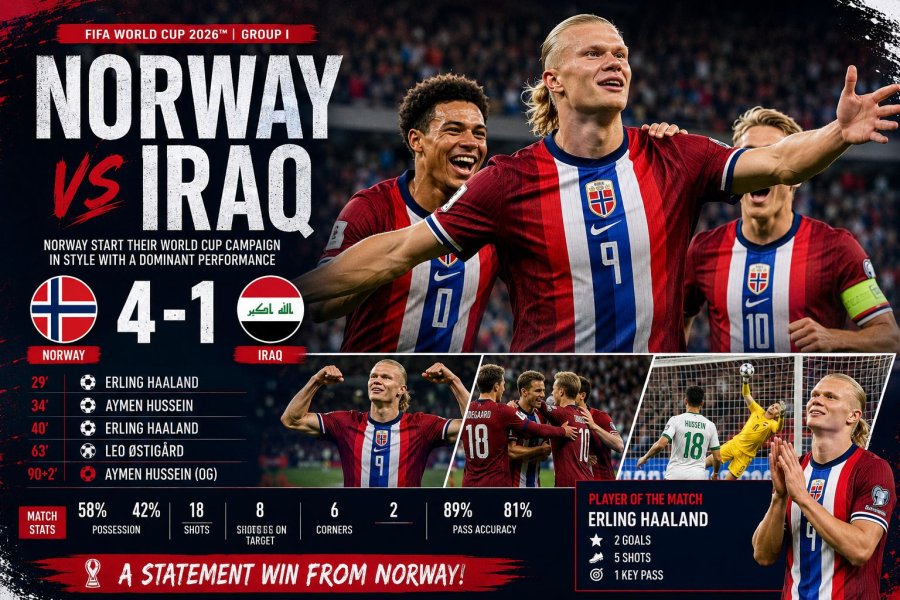
Norway could hardly have wished for a better start to its 2026 FIFA World Cup campaign. In an entertaining Group I encounter, the Scandinavian side defeated Iraq 4–1 in a match that highlighted the quality of Norway's attacking football and the brilliance of Erling Haaland on the biggest stage.
For years, Norwegian football fans have waited to see their nation return to the FIFA World Cup. With one of Europe's most talented generations, expectations have steadily risen, and the opening match against Iraq provided the perfect opportunity to show the football world what this team is capable of.
Norway didn't disappoint.
Led by captain Martin Ødegaard and powered by a clinical performance from Erling Haaland, Norway controlled large portions of the match, scoring four goals while limiting Iraq's opportunities. Although Iraq briefly fought back with an equalizer, Norway's superior quality eventually proved decisive as they secured all three points.
The emphatic 4–1 victory places Norway in a strong position in Group I and immediately boosts confidence ahead of the team's upcoming fixtures.
A Fast-Paced Opening
The opening stages saw both teams begin confidently, each looking to establish control of possession.
Iraq entered the match knowing they would be considered underdogs, but they refused to sit back completely. Their midfield pressed aggressively during the early exchanges, forcing Norway to remain patient in possession.
Norway gradually began to dictate the tempo through Martin Ødegaard, whose vision and passing quickly became the difference in midfield. Every attack seemed to flow through the Arsenal playmaker, whose ability to find space between Iraq's defensive lines created constant problems.
Antonio Nusa also impressed from the opening whistle, using his pace and dribbling ability to stretch Iraq's defence on the left wing.
Despite Iraq's determined start, Norway looked increasingly dangerous every time they moved into the final third.
Haaland Opens His World Cup Account
The breakthrough finally arrived in the 29th minute.
Norway patiently worked the ball through midfield before Antonio Nusa found David Møller Wolfe making an overlapping run. Wolfe delivered a dangerous cross into the penalty area where Erling Haaland timed his run perfectly.
The Manchester City striker needed only one touch to guide the ball into the net from close range.
It was a historic moment.
After years of dominating club football, Haaland finally scored his first goal at a FIFA World Cup, and the celebration reflected the significance of the moment. His teammates quickly surrounded him as Norwegian supporters erupted inside the stadium.
The goal rewarded Norway's dominance and gave them the confidence to push forward even more aggressively.
Iraq Responds with Determination
Many expected Iraq to struggle after conceding first.
Instead, they responded admirably.
Just minutes after Norway took the lead, Iraq found an equalizer through experienced striker Aymen Hussein. The forward capitalized on a rare defensive lapse and finished confidently to bring Iraq level.
For a brief period, the match completely changed.
Norway suddenly found themselves under pressure, while Iraq's players grew in confidence with every successful attack. The equalizer energized both the team and its supporters, creating one of the most exciting spells of the contest.
Credit must be given to Iraq for refusing to collapse after falling behind.
Their determination demonstrated why they earned qualification for the tournament in the first place.
Norway Quickly Restores Control
The joy for Iraq, however, was short-lived.
Rather than allowing the equalizer to affect their confidence, Norway responded like an experienced tournament team.
Only minutes later, Erling Haaland struck again.
A misunderstanding in Iraq's defence allowed the Norwegian striker to capitalize, calmly finishing past goalkeeper Jalal Hassan to restore Norway's advantage before halftime.
The second goal proved crucial.
Instead of entering the dressing room level at 1–1, Norway regained complete momentum and headed into the break leading 2–1.
Psychologically, it was a massive moment that shifted the match firmly back in Norway's favour.
Ødegaard Pulls the Strings
Although Haaland rightly earned headlines for his two goals, Martin Ødegaard quietly produced another outstanding performance.
The Norwegian captain controlled possession throughout the match, dictated the tempo, and consistently created dangerous opportunities for teammates.
His passing accuracy, movement between the lines, and leadership allowed Norway to dominate midfield for long periods.
Whenever Iraq attempted to build momentum, Ødegaard slowed the game, recycled possession, and patiently waited for openings to appear.
His influence extended beyond statistics.
He simply made everyone around him better.
Antonio Nusa, David Møller Wolfe, and Haaland all benefited from the captain's intelligent decision-making.
Norway Extends Their Lead
The second half followed a familiar pattern.
Norway controlled possession while Iraq searched for opportunities on the counterattack.
The decisive third goal eventually arrived from a set piece.
Martin Ødegaard delivered a perfectly weighted corner into the penalty area where defender Leo Østigård rose highest to power a header beyond the goalkeeper.
The goal effectively ended Iraq's hopes of mounting another comeback.
Leading 3–1, Norway played with increasing confidence and composure.
The defenders remained organized while the midfield patiently controlled possession, forcing Iraq to chase the game.
Relentless Pressure Brings a Fourth Goal
Even with a comfortable lead, Norway refused to ease off.
The attacking pressure continued throughout the closing stages as fresh substitutes maintained the team's high intensity.
Late in the match, Norway's persistence forced another mistake inside Iraq's penalty area.
The ball eventually deflected into the net for an own goal credited against Aymen Hussein, making the final score 4–1.
Although unfortunate for Iraq's goalscorer, the own goal reflected Norway's constant attacking pressure.
The Scandinavian side continued creating opportunities until the final whistle.
Tactical Analysis
Norway's victory was built upon several key tactical strengths.
Midfield Control
Martin Ødegaard consistently found pockets of space, allowing Norway to dominate possession while controlling the pace of the game.
Width in Attack
Antonio Nusa and David Møller Wolfe stretched Iraq's defensive shape, creating space for Haaland inside the penalty area.
Clinical Finishing
Norway required relatively few clear chances to score four goals.
Their efficiency in front of goal proved to be the biggest difference between the two sides.
Defensive Organization
Despite conceding once, Norway remained disciplined throughout most of the match and prevented Iraq from creating sustained pressure.
Iraq Showed Character Despite the Defeat
While the final score appears one-sided, Iraq produced several encouraging moments.
Their equalizing goal demonstrated composure under pressure, while their work rate throughout the match never disappeared.
The biggest issue proved to be defensive concentration.
Against world-class players like Haaland, even small mistakes are punished immediately.
Iraq will undoubtedly review the match carefully before their next group fixture, focusing on improving defensive organization while building upon the positive attacking moments they created.
Haaland Steals the Headlines
Every major tournament has players capable of becoming its biggest stars.
Erling Haaland reminded everyone why many believe he belongs in that category.
His two goals showcased everything that makes him one of football's most feared strikers—excellent positioning, physical dominance, intelligent movement, and ruthless finishing.
Perhaps even more importantly, he appeared completely comfortable under World Cup pressure.
If Haaland maintains this level throughout the tournament, Norway will become an extremely difficult opponent for any nation.
What This Result Means for Group I
Opening matches often shape an entire group stage campaign.
Norway now has three valuable points and a healthy goal difference after scoring four goals in their first outing.
Beyond the points, the performance itself sends an important message to the rest of Group I.
Norway demonstrated attacking quality, tactical discipline, and the ability to respond immediately after conceding.
Those qualities are essential for any team hoping to make a deep World Cup run.
For Iraq, the defeat means future group matches become even more significant. The team still has opportunities to recover, but improving defensive consistency will be vital if they hope to challenge for qualification.
Final Thoughts
Norway's 4–1 victory over Iraq was one of the standout performances of the opening round of the 2026 FIFA World Cup.
The match had everything football fans enjoy: attacking football, momentum swings, individual brilliance, and five goals. Norway looked confident from start to finish, while Iraq showed admirable resilience despite the disappointing result.
Erling Haaland's World Cup debut will rightly be remembered for his two goals, but this victory was about much more than one player. Martin Ødegaard orchestrated the midfield, Antonio Nusa and David Møller Wolfe constantly threatened from wide areas, and Leo Østigård added a crucial goal that effectively sealed the contest.
With a convincing 4–1 win, Norway has announced itself as one of the tournament's most exciting teams. If this opening performance is any indication of what's to come, the Scandinavian nation could become one of the surprise packages of the 2026 FIFA World Cup.
For Iraq, the road ahead becomes more challenging, but there were enough positive moments to believe they can still compete strongly in the remainder of the group stage.
One thing is certain: Norway has arrived, and after such an impressive opening display, the football world will be watching closely to see what they do next.