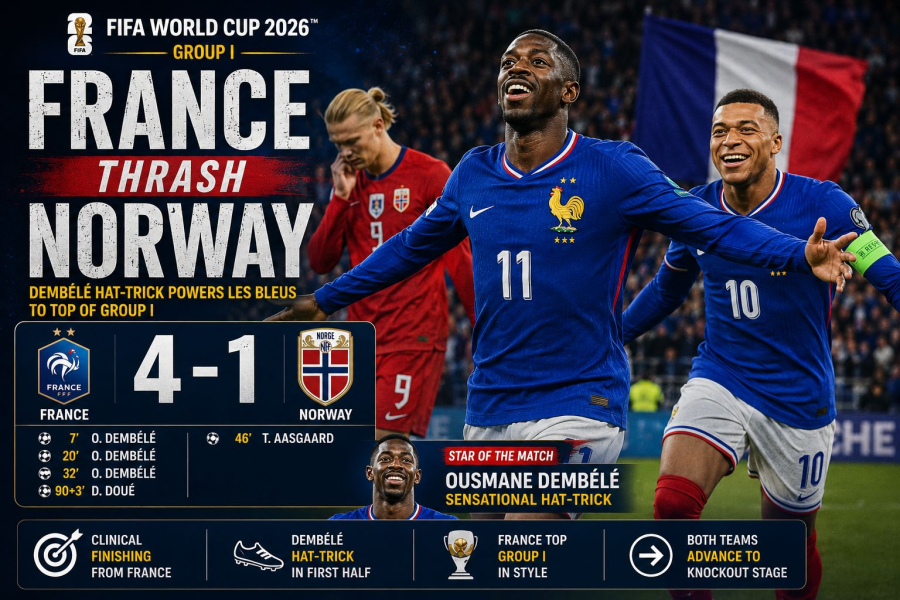
France produced one of the standout performances of the 2026 FIFA World Cup group stage with a convincing 4–1 victory over Norway, securing first place in Group I and sending a strong message to the rest of the tournament. Played before a packed crowd at Boston Stadium, the match showcased France's attacking brilliance, tactical discipline, and remarkable squad depth. While Norway had already put themselves in a strong position to qualify for the knockout stage, they were unable to cope with France's relentless intensity, as Ousmane Dembélé delivered a sensational first-half hat-trick to inspire Les Bleus to an emphatic victory.
The encounter had been billed as one of the most anticipated matches of the group stage. France entered the game unbeaten and looking to finish at the top of the group, while Norway hoped to continue their impressive World Cup campaign after producing several encouraging performances earlier in the tournament. Football fans around the world were particularly excited by the possibility of seeing Erling Haaland and Kylian Mbappé go head-to-head, but Norway opted to rotate parts of their squad with qualification already within reach, leaving Haaland on the bench for the opening stages.
France immediately seized control after the opening whistle. Didier Deschamps' side dominated possession, moved the ball confidently through midfield, and stretched Norway's defensive shape with quick passing and intelligent movement. Every attack looked purposeful, and it quickly became clear that France intended to dictate the pace of the match rather than allow Norway any opportunity to settle.
The breakthrough arrived in just the seventh minute.
A flowing attacking move carved open the Norwegian defense before Ousmane Dembélé calmly finished past the goalkeeper to give France a deserved 1–0 lead. The early goal immediately shifted momentum in France's favor and forced Norway to spend even more time defending inside their own half.
Rather than slowing down after taking the lead, France continued to attack with confidence. Their midfield controlled possession brilliantly, while Mbappé's pace and movement consistently created space for teammates. Norway struggled to regain possession, and when they did, France's pressing quickly forced mistakes.
The pressure resulted in France's second goal during the 20th minute.
Once again, Dembélé was in the right place at the right time. Following another well-worked attacking move, the winger produced a composed finish to double France's advantage. At 2–0, Norway faced an uphill battle against one of the strongest squads in international football.
Despite the difficult situation, Norway refused to surrender. Their midfield began pressing more aggressively, and they attempted to play with greater urgency whenever opportunities appeared. Those efforts were rewarded almost immediately after the restart.
Just seconds into the second half, Thelo Aasgaard found the back of the net to reduce the deficit to 2–1. The goal breathed fresh life into Norway's performance and briefly raised hopes of an unlikely comeback. Norwegian supporters sensed an opportunity as their team finally managed to apply pressure in the attacking third.
However, France responded exactly as world-class teams often do.
Instead of allowing Norway's goal to change the momentum, France calmly regained control of possession and continued playing their attacking football. Their confidence never wavered, and their response was both swift and ruthless.
Only minutes later, Dembélé completed a remarkable first-half hat-trick, restoring France's two-goal advantage at 3–1. His third goal capped a sensational individual display that highlighted every aspect of his game—intelligent movement, explosive acceleration, outstanding technique, and clinical finishing. Norway's defenders simply could not contain him throughout the opening period.
As the match progressed, France demonstrated why they remain one of the favorites to lift the World Cup trophy. Rather than sitting back to protect their lead, they continued pressing high up the pitch, forcing Norway into uncomfortable situations whenever they attempted to build attacks from the back. Their midfield trio controlled the rhythm of the game with patience and precision, while the defense remained compact and disciplined whenever Norway ventured forward.
Mbappé, although not among the goalscorers, played a hugely influential role throughout the contest. His pace constantly stretched Norway's defensive line, creating valuable space for Dembélé and the supporting midfielders. His intelligent movement and creative passing ensured that France remained dangerous every time they entered the final third.
Norway worked tirelessly throughout the second half but found clear scoring opportunities difficult to create. Their attacking rhythm was disrupted by France's aggressive pressing, and every mistake in possession allowed Les Bleus to launch another dangerous counterattack. Although Norway's players continued to fight until the final whistle, the quality gap between the two teams became increasingly apparent.
France completed the scoring in second-half stoppage time through Désiré Doué.
The young attacker capped an impressive team performance by finishing confidently after another rapid attacking move. The goal made the final score 4–1 and accurately reflected France's dominance over the ninety minutes.
For France, the victory represented far more than three points. Finishing top of Group I meant entering the knockout stage with tremendous confidence and momentum. More importantly, the performance showcased the depth of talent available throughout the squad. With Dembélé in outstanding form, Mbappé continuing to influence matches, and younger players like Doué making valuable contributions, France demonstrated that they possess multiple attacking threats capable of deciding matches against elite opposition.
Ousmane Dembélé deservedly received widespread praise after the final whistle. His hat-trick was one of the finest individual performances of the tournament's group stage and underlined his importance to the French attack. Every goal displayed a different aspect of his finishing ability, while his work rate without the ball caused Norway constant problems throughout the evening.
For Norway, the defeat was disappointing but ultimately not catastrophic. Thanks to their earlier results in the group, they still qualified for the knockout rounds despite the loss. Manager Ståle Solbakken chose to rotate parts of his squad, including limiting Haaland's involvement, with an eye on the challenges that awaited beyond the group stage. Although the tactical gamble did not produce the desired result against France, Norway remained optimistic about their chances moving forward.
The match also served as a valuable lesson for the Norwegian squad. Against world-class opponents, small defensive lapses are punished immediately, and maintaining concentration for the full ninety minutes is essential. Despite the heavy defeat, Norway showed resilience by continuing to compete until the final whistle and will look to learn from the experience as they prepare for the knockout phase.
When the final whistle sounded, France had firmly established themselves as one of the leading contenders for the 2026 FIFA World Cup. Their attacking football was exciting, their defense remained organized, and their overall performance demonstrated both confidence and championship quality. Norway may have suffered a difficult evening, but qualification for the next round ensured that their World Cup journey remained alive.
Ultimately, France's 4–1 victory will be remembered for Ousmane Dembélé's unforgettable hat-trick and a complete team display that announced Les Bleus as genuine favorites to lift football's biggest prize. With momentum firmly on their side, France marched into the knockout stage looking every bit like a team capable of going all the way.
